Tips for Mountain Living

Drink LOTS of fluids!
It's very easy to get dehydrated at this altitude. If you begin to feel light headed, get a headache or feel sick to your stomach, it is possible that you are feeling the effects of altitude sickness. Sport drinks like Gatorade can really help to balance your electrolyte levels. The potassium in bananas will also help to balance you out.

The effects of colds can be amplified by the altitude and very young children with slight colds can easily develop ear infections. It is very important to keep taking fluids in to compensate for the rapid loss and to dilute the toxins in your system.

Drinks like coffee and alcohol can also accelerate the depletion of fluids and cause dehydration.

We always have a sport drink before going up the ski hill to prepare our systems.

Humidifiers are also very useful at altitude year round.

Cotton Clothing
Ahh, cool, comfortable cotton. the cotton advisory board won't care for this, but the truth in snow country is that cotton absorbs moisture, compresses and will cause chafing and chilling. If you like cotton, and we do, wear it in a blend with wool and/or polypropylene so that the moisture will be wicked away from your skin so it can evaporate.

Dress in Layers

Dress in light layers that can be peeled or added as the weather demands. Poly blend with wool/cotton long underwear as a base layer, a thin wickable poly turtleneck with neck zip and a quality poly fleece jacket or pullover under a breathable laminate shell jacket is an ideal combo.
Goretex® is a wonderful breathable laminate but Sympatex® is even better as it will not leak if it gets dirty.

Polypropylene and poly/wool blend socks with smooth seams will keep your feet happy. Put them on under your long underwear, that way your ankles will be protected from the underwear seams and your socks won't work their way down. Simple but effective.

Leave the heat on
You can turn the thermostat down, but leave it at least at 50-55 degrees. Otherwise your water pipes can freeze and burst. No fun at all.

Warm up your car
Your engine receives the most wear when you first start it up. Up here, the coolant in the water jacket and the oil temperature drops to the outside temperature, and the oil gets darn thick. It takes a while to warm up and thin out so it can be pumped back to the top of the engine. Let it warm up and save years of life, before driving.

Chains
Make sure that the chains you have actually fit your tires. Have them fit before heading up into the mountians, and that you know how to put them on correctly.
Chains usually have extra links on them to allow them to fit a range of tire sizes, and any extra links should be removed so that they don't do body damage. Most tire shops will have bolt cutters to remove extra links. Chains will stretch with use, so get a snug fit.
The cross links attach to the ring chain with crimped ends, and the smooth side must be next to the tire.

Install your chains by placing them over the TOP of your tire.
On front wheel drive cars you will generally want to back up, and on rear wheel drive, move forward, so that you have the maximum amount of room to fasten the chains.
Tuck just enough chain under the front of the tire in the direction of roll, so that the tire moves over the chain.
Stop when the chain rides up on the tire one third to one half the height of the tire so that you can reach the hook on the back of the tire chain.
Fasten the BACK or INNER hook FIRST, as snugly as you can get it. You may need to pull the chain over lugs on the tire so that any slack is removed.
THEN fasten the outer hook or latch as snugly as possible.
To take up any additional slack in the chains and to keep them secure as the chains stretch during use, get a set up rubber chain tighteners, (This applies to cable chains as well). START AT THE BOTTOM of the chain ring, and work to the top, hooking the tightener using even spacing. You start at the bottom, so that the tightener will snap DOWN and away from your face if it slips.

Low profile cars sometimes need to be fitted with cable chains because of limited clearance, but conventional link chains provide the best traction and fit.

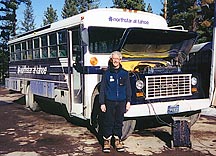
Mike Ski Resort Bus

Winter Driving

Driving can be dangerous, especially if you are not used to driving in snowy and icy conditions.
The road can appear dry, but "Black Ice" can form quickly, especially in shaded areas and on bridges. Driving more slowly can make all the difference.

The SPEED LIMIT on Snowy Roads is 30 MPH, including all Major Local and Interstate Highways; (I-80)

Driving in slick or snowy conditions in overdrive, if your vehicle is so equipped, is not recommended. Overdrive gives the effect of freewheeling and will not provide the engine compression necessary to slow your vehicle. It is really designed for highway travel on flat dry pavement, and is meant to allow your engine to operate at lower engine speeds to decrease wear and conserve fuel.

Always brake GENTLY, look far down the road and leave plenty of room between yourself and the vehicle in front of you.

If you start to slide, TAKE YOUR FOOT OFF the brake pedal. Your wheels must be turning for you to have any control in the snow or on ice. If your brakes are locked, and that can happen even with "anti-lock" brakes, you WILL continue to slide until you hit something.

Once your wheels are turning again and you regain steering control, reapply your brakes gently, with even pressure.

There are two basic slides that are likely to happen.

The Rear Wheels Slide
When your rear wheels break loose, the back of the vehicle attempts to overtake the front. You must turn the steering wheel in the direction that the rear wheels are sliding until the front and rear wheels are lined up again and then countersteer the steering wheels back to center, otherwise you will begin to slide in the opposite direction.
This must be done in a smooth and gentle motion, as any extreme steering will only amplify the sliding affect.
Again, this can only be accomplished if your foot is OFF the brake pedal. Also, letting OFF the gas pedal will cause engine compression to slow the wheels and allow them to get traction.

Front Wheel Slide
With a front wheel slide, the steering wheels have lost their grip on the road, and the vehicle continues to slide in the direction of travel, even though the wheels are turned.
Taking your foot off the brake or accelerator will cause engine compression to slow the vehicle. You must straighten the steering wheels to allow the tread to bite into the surface and begin rolling again so that you can regain traction. Again, gentle, smooth movement is the key to regaining control.

Don't be lulled into a false sense of security by that expensive 4 wheel drive you just bought. 4 wheel drive will give you more pulling power, but will slide just as easily as a 2 wheel drive, even with chains. SLOW DOWN, your life may depend on it.

Please remember that the commercial you watched that showed a four wheel drive vehicle bounding through hip deep snow at high speed was driven by a professional driver on an empty road under controlled conditions.
It is marketing hype and as such, bears no resemblance to reality. Just because you paid a fortune for it, doesn't mean that you can safely drive at freeway speeds in the snow.
You CAN'T.

As a ski resort bus driver, the most dangerous part of my job is avoiding divers of SUV's who overestimate the traction ability of their vehicles and come sliding into my lane.

You are here to have fun, not end up in a ditch, in the hospital or worse.
Please don't pass long lines of cars, snowplows, or where you can see less than a half mile or more down the road.
NEVER pass going into a blind corner, When the roads are slick, you may lose control trying to get back in your lane.

Professional drivers up here have horror stories about pulling people out of cars tangled up in huge rotary snowplows that they tried to pass. The police have zero tolerance for risky driving and local drivers will report you on their cell phones.

Trying to save a few minutes may cost someone their life. Relax, enjoy the scenery.
The hustle and bustle will be waiting for you when you get home.

If you want to really see the ability of your vehicle, hang out at the ski resort after it closes and everyone leaves or find an empty parking lot, and do some braking and acceleration tests. I think you will be surprised how easily you can lose it, even in four wheel drive.

Even with chains on, it's easy to spin a few circles, and is really an eye opener.

It's my sincere hope that this information will help you in your winter travels. The weather can change rapidly in the mountains, and go from clear and dry to snow in a matter of minutes. Be prepared both physically and mentally, use common sense, and actively develop your winter driving skills.

That all said, drive slow, safe and have a great time.

Mike

Check the weather and Hwy Conditions
http://www.magnifeye.com